
Multi-Ply Systems
Modified Bitumen Roofing
Multi-ply systems engineered for industrial strength. Superior impact resistance, foot traffic durability, and reliable performance for demanding commercial environments.
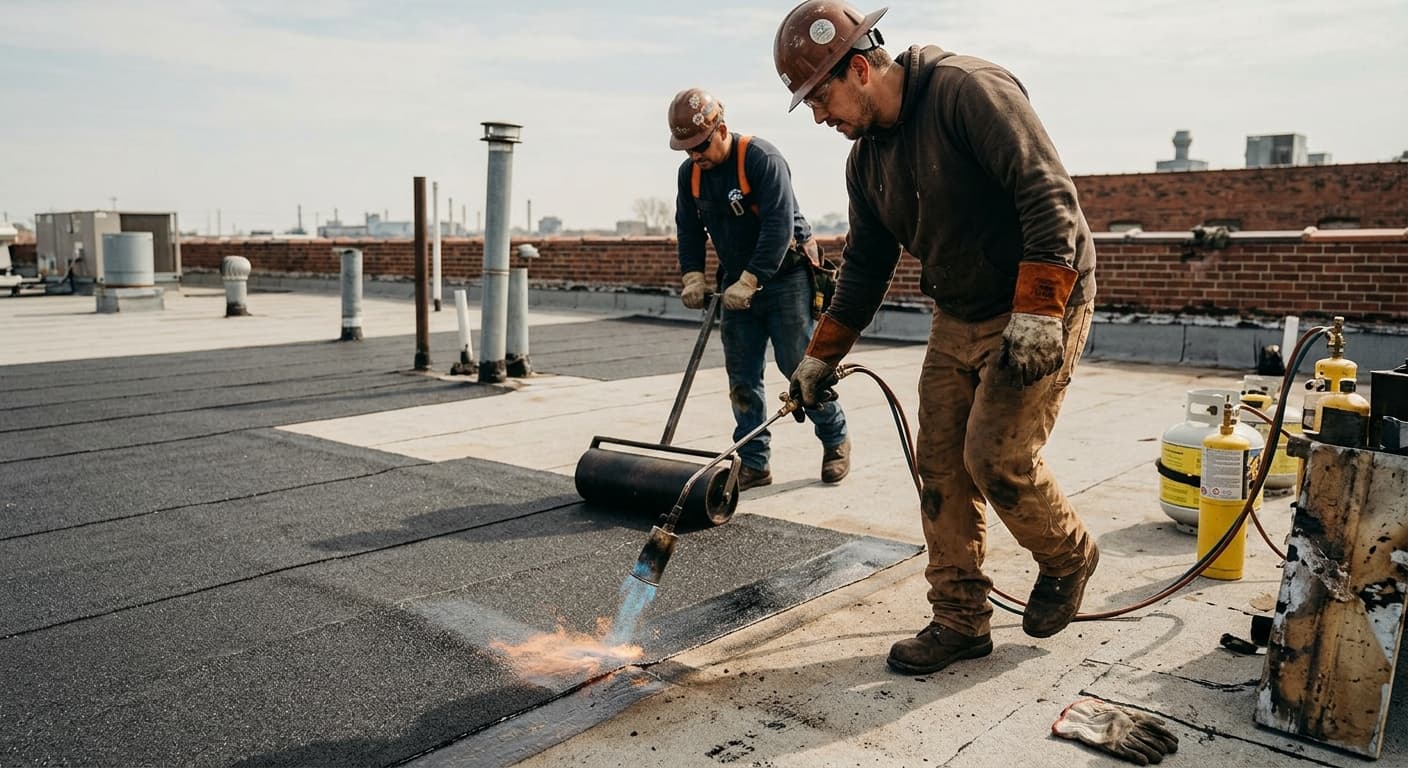
What Is Modified Bitumen?
The Multi-Ply Advantage
Modified bitumen roofing is an evolution of traditional built-up roofing (BUR), enhanced with polymer modifiers, either APP (Atactic Polypropylene) or SBS (Styrene Butadiene Styrene), to improve flexibility, elongation, and temperature performance.
Unlike single-ply systems, modified bitumen is a multi-layer assembly: a base sheet mechanically fastened or adhered to the substrate, followed by one or more cap sheets for surface protection. This redundant construction provides inherent resistance to punctures, foot traffic, and mechanical damage: qualities that single-ply systems cannot match.
For industrial facilities, manufacturing plants, rooftop mechanical equipment areas, and buildings with high foot traffic demands, modified bitumen remains one of the most appropriate solutions available.
System Overview
APP vs. SBS: Two Modifier Types
APP: Atactic Polypropylene
Application: Torch-applied or hot-mopped
- Superior UV and heat resistance
- Higher softening point: ideal for hot Southeast climates
- Smooth or granulated surface options
- Torch application fuses layers for watertight bond
- Common in re-roofing over existing BUR systems
SBS: Styrene Butadiene Styrene
Application: Cold-applied adhesive or self-adhered
- Rubber-like flexibility: accommodates building movement
- Better performance in temperature extremes
- Cold-applied: no open flame required on site
- Self-adhered versions simplify installation
- Preferred for occupied buildings during re-roofing
Technical Specifications
| Property | APP | SBS |
|---|---|---|
| Tensile Strength | 200+ lbf/in | 175+ lbf/in |
| Elongation at Break | 25 to 40% | 50 to 150% |
| Softening Point | 230°F+ | 190°F+ |
| Low-Temp Flexibility | -4°F | -22°F |
| Fire Rating | Class A (with suitable cap) | Class A (with suitable cap) |
| UV Resistance | Excellent | Good (requires coating) |
| Puncture Resistance | High | High |
| Foot Traffic Tolerance | Excellent | Good |
| Warranty Range | 10 to 15 years | 15 to 20 years |
Best Applications for Modified Bitumen
- Roofs with heavy foot traffic and frequent equipment service
- Industrial and manufacturing plants
- Buildings with a lot of rooftop mechanical equipment
- Hospitals, schools, and institutional buildings
- Smaller low-slope roofs with many penetrations and details
- Re-roofing where a multi-ply assembly is specified
Our Modified Bitumen Installation Process
Roof Assessment
Infrared scan where applicable, core samples, and deck inspection to confirm the existing assembly and its moisture condition.
System Specification
APP or SBS, the number of plies, and the application method (torch, cold adhesive, or self-adhered) are chosen for the building, its occupancy, and local code.
Substrate and Base Sheet
Insulation and cover board are installed, then the base sheet is attached to create the first waterproofing layer.
Cap Sheet Installation
The granulated cap sheet is applied with staggered, fully bonded laps. Torch work follows CERTA safety procedures, including a fire watch after the torch is shut off.
Flashing and Detailing
Walls, curbs, penetrations, drains, and edge metal are completed to manufacturer detail requirements.
Final Inspection & Warranty
Manufacturer inspection where the warranty requires it. Warranty registered in the owner's name and a full documentation package delivered.
Common Questions
Frequently Asked Questions
What's the difference between APP and SBS modified bitumen?
APP (Atactic Polypropylene) and SBS (Styrene Butadiene Styrene) are two different polymer modifiers that change the performance characteristics of the base bitumen. APP produces a harder, more UV-resistant membrane ideal for hot Southeast climates and is typically torch-applied. SBS produces a rubber-like, flexible membrane that performs better in temperature extremes and is cold-applied, making it preferable for occupied buildings where open flame is not permitted. We specify based on your building conditions and application requirements.
How does modified bitumen compare to single-ply membranes like TPO?
Modified bitumen is a multi-ply system, typically 2 to 3 layers, which gives it superior resistance to punctures, foot traffic, and mechanical damage compared to single-ply systems. The tradeoff is higher installed cost and weight. For industrial roofs, warehouses with heavy rooftop equipment, or any application with regular foot traffic, modified bitumen often outperforms single-ply over the long term. For standard low-traffic commercial roofs, TPO or EPDM is usually more cost-effective.
Is torch-applied modified bitumen safe to use on occupied buildings?
Torch-applied APP modified bitumen involves open-flame equipment, which requires specific site conditions and trained installers. For occupied buildings, we typically specify self-adhered or cold-applied SBS systems that eliminate the open flame entirely. Seal Top holds CERTA certification, the industry standard for safe torch-applied roofing, and our crews follow strict fire prevention protocols when torch application is required. We assess each project and recommend the installation method that best balances performance and site safety.
How long does a modified bitumen roof last?
A properly installed 2-ply modified bitumen system typically lasts 15 to 20 years. A 3-ply system with a granulated APP cap sheet can reach 20 to 25 years in Southeast climates with proper maintenance. Key factors are installation quality, drainage design, and granule protection on the cap sheet. We provide maintenance recommendations at closeout to maximize your roof's service life.
Can modified bitumen be installed over an existing built-up roof?
Yes, modified bitumen is frequently specified as a re-roofing system over existing BUR (built-up roofing) assemblies. The existing substrate must be structurally sound and free of excessive moisture. We perform a core cut analysis and infrared scan before recommending a recover. If the BUR is in acceptable condition, a modified bitumen overlay can extend the roof's life without the cost and disruption of full tear-off.
Is Modified Bitumen Right for Your Building?
We'll evaluate your roof, foot traffic requirements, and budget to recommend the optimal system.
7am, 7pm | Mon, Sun | 24/7 Emergency Response Available